1883-Present
Judson Missionary Baptist Church
dba Judson Baptist Church and/or First Baptist Church
Judson, Gregg County, Texas TX
Hiram Whatley owned property in northern Gregg County, TX, as early as 1870 because the harsh reconstruction laws in Alabama were uncomfortable for this Baptist farmer and mule trader. His first five children were born in Henry County, Alabama, but the final four children were born in Gregg County, Texas, after 1874. Hiram and his wife, Georgiana, were the early benefactors of the Judson Missionary Baptist Church donating land for the church building. Their son, Hiram Augustus “Gus” Whatley, donated land for the cemetery west of the present church building. Though other sources shed additional light on this congregation, I choose to replicate their history as presented on a typed, water-stained, taped, framed document posted on the church wall next to a picture of Hiram and Georgiana Whatley. It is entitled The History of Judson Missionary Baptist Church.
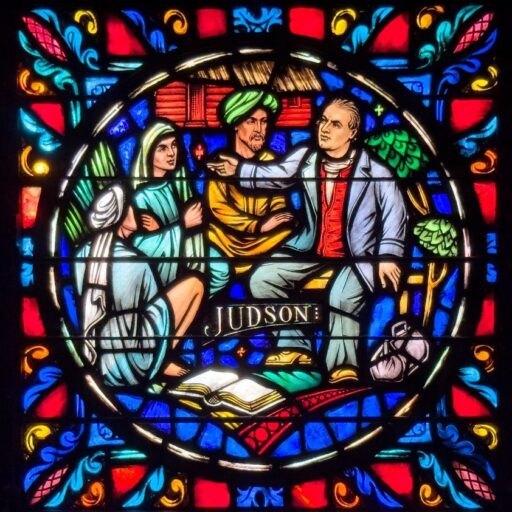
Judson Baptist Church was organized September 14, 1883, with Elder W.B. Brewer and Deacons S.B. Smart and A.E. Hiett composing the presbytery. These brethren had been called upon by their brethren at Lawrenceville school house which is now known as the L.L. MacKey tract, Judson Community, Longview, Gregg County, Texas. It was not until about 1885, however, that the name Judson was given to the church at the suggestion of the late (grandmother) Hiram Whatley. The name was chosen because of a church in Alabama to which one of the charter members had belonged. In Alabama the name had its origin as the namesake of Judge Adaniram [sic] Judson, a great missionary to Burma and Asia.
As far as can be determined by the records which are available, the following were charter members: Mr. and Mrs. G.C. Renfro, Mrs. Hiram Whatley, Mr. and Mrs. R.D. Smith, A.E. Hiett, and S.A. Smart.
These people deemed it necessary to organize Judson Baptist Church because there was no other church of like faith in their immediate neighborhood. In keeping with the principals of the Missionary Baptist Church, her government was that of a democratic nature. The Articles of Faith stated that the governmental power is in the hands of the people; that the right of a majority of the members of their church should rule, in accordance with the law of Christ, and that the power of the church could not be alienated, and that church action was and is final.” The church also set forth in her Articles of Faith those which are presented in J.M. Pendleton’s original Church Manual.
The records of the church tell of her election of messengers in 1886-1887 to participate in matters of business, which was occasioned annually through the gathering of sister churches at Associational and District meetings.
On Sunday September 26, 1891, a committee composed of J.H. Newton, G.C. Renfro, and A.H. Crawford submitted to the church recommendations and specifications of a building of worship. April 22, 1893, a committee was chosen to appoint a site for the building. Mr. and Mrs. Hiram Whatley donated the plot of ground on which the present building is located.
The third Sunday in July, 1901, the body elected to organize a Sunday School, the first to be organized in the new building.
The first Sunday in November, 1902, sister Viola Stevens was elected to organize the Ladies Auxiliary, and the following were appointed to the offices: Miss Mary McLendon, president; Miss Eliza Smith, vice-president; Mrs. Vanny Fuller, secretary; Miss Effie Smith, treasurer.
April 1, 1922, a designated time for regular worship sessions of weekly prayer meetings was set.
The church’s first record of an organized Baptist Young People’s Union was set on April 6, 1924, when a committee was appointed by the church to recommend officers to serve in this capacity.
After a number of fruitful years of worship in its old building, the church dedicated a new building, October 6, 1935, composed of a main auditorium and four classrooms. The dedication sermon was preached by Elder C.L. Cameron. September 12, 1937, the church elected to begin half time work, designating as its time for regular worship services the first and third Sundays of each month.
April 2, 1938, the church organized other Sunday school classes, and in January 1939, new classrooms were completed and dedicated.
It was also in 1939 that a plan was adopted whereby all money would come through one common treasurer of the church.
On December 7, 1941, the church elected to begin full-time pastoral work.
A church parsonage was completed and occupied in October, 1947, which added immeasurably to the church facilities.
At the present time there are three ordained ministers and seven deacons in the church membership.
Mrs. A.C. McAfee is the present church clerk, and has served the church in this capacity since September, 1924.
The following is a list of the pastors and the years they served:[1]
It is interesting to note that the church had constructed a building (1893), organized a Sunday school (1901), a Ladies Auxiliary (1902), a regular prayer meeting (1922), a youth group (1924), and built a second building (1935) before they ever had even a half-time pastor (1937). The first full-time pastor arrived on Pearl Harbor Day, December 7, 1941.
+++++++++++++++
[1]The list of pastors contains names of 22 pastors serving from 1883 to 1945. The compiler visited this congregation on November 30, 2025.